February 22, 2026
An internal Homeland Security document shows how ICE plans to cram thousands of detained human beings inside a Georgia warehouse.
So often in the iPhone Age, the whole world is watching the ugly side of humanity as captured on video, from murder in the snowy streets of Minneapolis to a plainclothes Pennsylvania police chief appearing to place a protesting teen girl in a choke hold.
But sometimes evil is buried deep in the black-and-white paperwork of government bureaucracy.
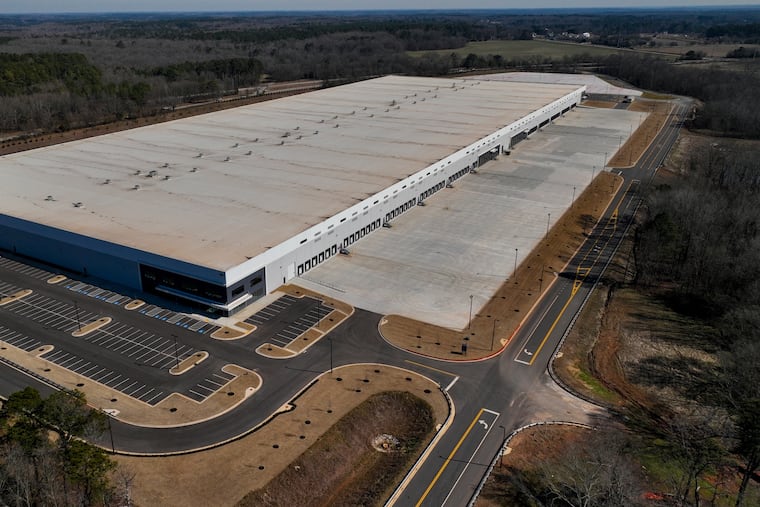
A once sleepy rural town named Social Circle, Ga. — just over 40 miles east of Atlanta off Interstate 20 — has become the epicenter of the stealthy plan by U.S. Immigration and Customs Enforcement (ICE) to rapidly create an American gulag archipelago of massive former warehouses adapted into detainment camps for arrested immigrants.
The plan to convert a newly built 1.2 million-square-foot warehouse into a concentration camp where as many as 8,500 humans — double the size of the current largest federal prison — would be housed for as long as 60 days (or likely more) has riled up both residents and public officials in a place where 75% voted for Donald Trump in 2024.
The frustrated city manager of Social Circle, which was offered no input as a cash-flush ICE recently bought the spec warehouse for a whopping $128 million, told the Guardian that he’s denying the feds’ request to turn on the public water as they race to open their detention camp there as early as April.
“I told them I’m not going to do it,” Eric Taylor said. “Not until they come and talk to me.”
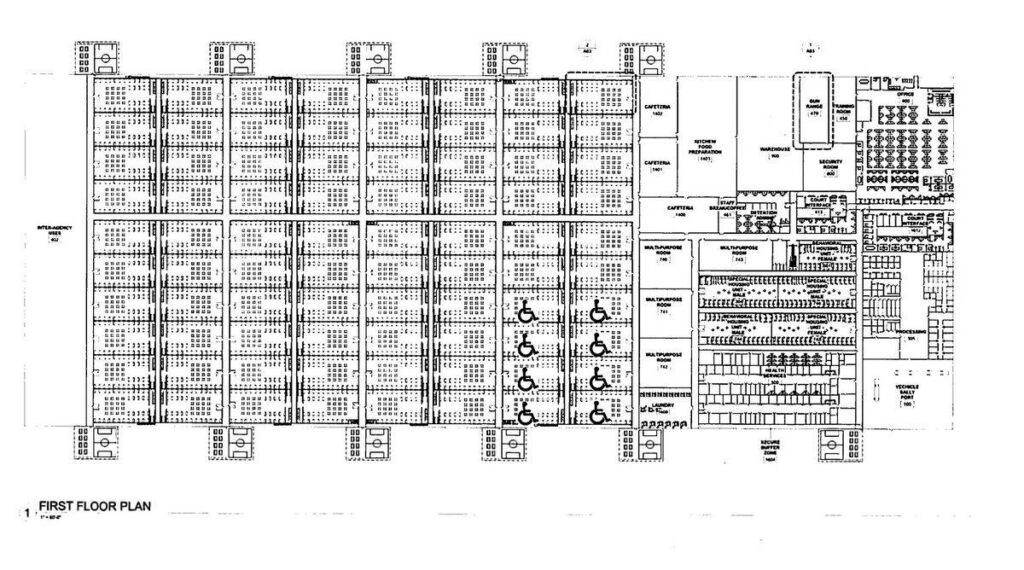
But officials in the small town of just 5,000 also did something else that probably raised some hackles at Kristi Noem’s ultrasecretive U.S. Department of Homeland Security. They made public what few documents DHS has so far been willing to share with Social Circle, including its blueprint for what the innards of an American gulag will look like.
Close to two-thirds of the massive, rectangular floor plan is divided into 80 squares separated by narrow corridors, each box with dozens of strike marks. The thousands of marks presumably represent bunk beds, but what they truly signify is human beings.
Based on the most recent statistics, as many as 70% of these arrested and handcuffed immigrants will have committed no crime after entering the United States — day laborers, restaurant workers, or Uber drivers now crammed into a prison camp unlike anything seen on U.S. soil since World War II’s immoral Japanese internment.
The new floor plan raises more questions than it answers. It’s not clear whether the small boxy rooms surrounding the rectangular detention space would be used for recreation, as no recreation space is explicitly marked. There are three cafeteria rooms and a medical space — a necessity in an instant town of 8,500 — yet still room for an indoor gun range where hundreds of guards will hone their shooting skills. Eight rooms are marked as handicap accessible, so there’s that.
This banal blueprint for inhumanity is the embodiment of the notorious words last April from ICE’s acting director, Todd Lyons, who said the Trump regime wants to make deportation “like [Amazon] Prime, but with human beings.” Indeed, the ultimate goal of stacking desperate people in dingy, dehumanizing concrete caverns built for bath mats or pet treats is to force them to abandon their legal right to fight for U.S. asylum and agree to leave the country, bringing Trump closer to his goal of one million deportations every year.
“The focus on speed is extremely concerning,” Sari Arvey of Human Rights First’s ICE Flight Monitor told Georgia Public Broadcasting, referring to the goals of getting detainees in and out in 60 days. “If they’re trying to speed up this process even further, it’s only going to extremely exacerbate the due process violations, the separation of families, [and] also conditions in detention centers.”
Online, the blueprint of detainees forced to live in such crammed conditions — a necessity to house 8,500 people in one building, even a warehouse the size of roughly 20 football fields — prompted comparisons to some of the worst of human history. Some on Bluesky linked the Social Circle blueprint to diagrams of tightly packed ships that brought enslaved Africans to America in the 18th century, while others wondered if the boxy quarters would look just like the rows of bunk beds inside Auschwitz, the Nazi death camp.
No one is suggesting ICE is planning anything close to mass extermination, but experts do say floor plans like this are more evidence that what the Trump regime, with its ambitions for a national network of as many as 24 converted warehouses, is racing to create is clearly comparable to history’s worst concentration camps.
In a conversation this weekend with New York Times columnist Jamelle Bouie, author Andrea Pitzer of One Long Night: A Global History of Concentration Camps called it “the purging of anyone that’s deemed the outsider or the foreigner. It has been weaponized into this much, much more dangerous state. And with the number of detention beds in terms of expansions and the warehousing, the potential for this, we’re really looking at stuff on the scale of the concentration camp systems that most people have heard of.”
As the existence of the ICE detention scheme has become a coast-to-coast controversy, Homeland Security has insisted these sites will be modern, well-run, and humane. “These will not be warehouses — they will be very well-structured detention facilities meeting our regular detention standards,” DHS said earlier this month.
The problem is that the recent history of ICE has shown its current “modern” detention sites are plagued by squalid conditions and rising rates of infectious disease and premature death. The idea that these same bad actors could achieve humane conditions in much larger, hastily assembled warehouses seems utterly ludicrous.
Earlier this year, Democratic U.S. Rep. April McClain Delaney visited an ICE detention center at a Baltimore federal building and reported “horrendous” conditions, with 50 people in a room with “concrete floors, a bench around the perimeter, and a makeshift bathroom in the middle that has minimal privacy.” Detainees recounted sleeping under foil blankets and experiencing hunger and thirst.
“Our patients are more frightened and sicker than ever,” three Philadelphia physicians who primarily treat immigrant communities wrote in a recent Times guest essay that described a variety of dire problems, including substandard treatment in ICE detention.
One case they described involved a stroke recovery patient who was arrested and detained by ICE for several weeks at the Moshannon Valley Processing Center in Central Pennsylvania before family members won his release.
“In detention he had missed weeks of medication, and he continues to deal with the undertreated effects of his stroke, which make walking difficult and returning to work impossible,” they wrote. “He told us he struggles to sleep through the night and often feels exhausted and depressed.” Meanwhile, large ICE detention camps in Texas have reported outbreaks of measles and tuberculosis.
The reality of the concentration camps that are planned for Social Circle or Tremont, Pa. — in a site that used to move cheap consumer goods for the now-bankrupt Big Lots — is that they are much more likely to breed disease and human misery than to alleviate them.
It’s not clear how far ICE can get with this scheme. Were ICE successful in its initial $38 billion plan to buy 24 facilities that could house as many as 76,500 detainees, it would need to arrest people in multiple cities on the scale that recently generated a national uproar in just one, Minneapolis. But the exposure of the detention proposal has also caused several planned purchases to collapse. This week, for example, officials in New York state claimed that a large, controversial site in the Hudson Valley town of Chester won’t be happening.
The irony is that what might be described as NIMBY (“not in my backyard”) issues — like not having enough drinking water or sewage treatment capacity for thousands of new arrivals, or the loss of tax revenue from warehouses meant for economic development — are giving permission to weak-kneed politicians afraid of the immigration issue to still oppose these sites without addressing the bigger human rights crisis.
To echo Malcolm X, these monstrosities should be stopped by any means necessary, even if it takes just turning off the water spigot. Still, the biggest reason to be outraged about this scheme for American concentration camps should not be infrastructure, but the rank immorality spelled out in the cold ink of the DHS floor plan.
It’s our challenge as the neighbors and allies of our nation’s immigrant communities to make sure those black marks on a page are never turned into the suffering of actual humans.
Found on Mainstream News