Nothing for Snitches: For a Revolutionary Anti-Repression

“UPDATE: This piece was written and submitted before the authors discovered that Fire Ant had quietly revised their original statement “Manufactured Betrayal,” instead of openly addressing the principled criticism they have received from comrades across the movement. The edited piece, which can now be found on the CrimethInc. website, is significantly altered from the original. It retroactively removes all language pertaining to an “off ramp” for snitches and redemption for the cooperator Meagan Morris. It also introduces new language making the case that Thomas’ and Baumann’s testimonies played a more significant role than Morris’ statements in furthering the state’s narrative. Needless to say, we find such blame shifting absurd, as every cooperator played an essential role in sending their comrades to prison. Despite Fire Ant’s edits, the substance of their piece has not changed, and our critique of their position still stands. The text of their original piece can be found here.

“The paramount issue is the character and integrity of the movements we are building. We must confront, vilify, and destroy traitors at every opportunity; deal with them as the dehumanized vipers that they are; instill ‘the greater fear.’ The political terms must always be clear: discredit and destroy all traitors.” – Sekou Odinga, Kuwasi Balagoon, Judy Clark, David Gilbert, Silvia Baraldini

In the wake of draconian sentences handed down to the Prairieland 8, each ranging from 30 to 100 years, much has been said about the role of Trump’s NSPM-7 in establishing new repressive tools for criminalizing activism. Less discussed has been the critical role of cooperation—by at least 6 of the Prairieland defendants—in securing these devastating convictions. While the terrain of repression is ever changing, what remains evergreen is our most powerful tool of anti-repression: the principle of non-cooperation with the state.

This statement is a call for unity against the forces that would nip any nascent revolutionary movement in the bud by suffocating its most basic survival instinct with equivocation about the need to keep out snitches. From its inception, the DFW Support Committee has chosen to include the cooperator Meagan Morris in its collective prisoner support effort, against the objections and concerns of many in the movement. Despite this controversy, the “anti-repression collective” known as Fire Ant Movement Defense has lent DFW significant media support, helping them popularize the “Prairieland 9,” despite there only being 8 non-cooperating defendants.

On July 7, 2026, Fire Ant published an essay called “Manufactured Betrayal” in CrimethInc. which serves as a justification for their practice. The piece proposes the possibility of an “off-ramp” for snitches, focusing in particular on Meagan Morris as an example of someone who “restore[d] their commitment to struggle” after informing on their comrades. By publishing this snitch apologia—along with Eric King’s rebuttal “No Way Home”[1] four days later—CrimethInc. has presented the question of if snitches should be welcomed back into the movement as if it is a debate with two sides—it is not.

By taking this position, these formations are setting the precedent that people can cooperate with the state and continue to receive the support of collective movement resources. We can only assume that welcoming snitches back into the fold is a position that DFW, Fire Ant, and CrimethInc. will continue putting into practice.

Meanwhile, those of us serious about building a revolutionary movement must unite around a collective commitment to the principle of non-cooperation. As a political, strategic, and ethical practice that prioritizes the collective movement over the individual, it is our only hope of withstanding escalating repression. Compromising on this principle destroys our basic capacity for self-defense. There can be no revolution without solidarity, and solidarity has no meaning without a commitment to non-cooperation.

– The Facts of the Situation –

Fire Ant claims that it is a strategic decision to bring cooperators back into the movement:

“At this moment, thousands of inexperienced new participants are flooding into the fight for liberation. We probably won’t be able to educate all of them before they find themselves in confrontations with the state. Some of them will experience intense repression designed to scare them into cooperating before they fully understand the political implications, the options available to them, or their basic rights. When they find themselves staring down the barrel of a gun, some may well say something they shouldn’t. If we immediately make permanent enemies of everyone who do so, this may further endanger others.”[2]

This, however, is a complete distortion of the facts of Morris’ betrayal, and is the exact opposite of a strategic decision in relation to cooperators. To address the dangerous position of allowing snitches to enter back into the movement that they have betrayed, we must first address how this is a complete minimization of the extent of Morris’ cooperation.

According to her statement to law enforcement, Morris joined the Socialist Rifle Association in 2020 and learned of the noise demo from a Signal chat she joined “years ago after attending a protest.”[3] In another Signal chat that members suspected of being infiltrated, she stated that “if there are 4 or more liberals in a chat, there’s likely law enforcement.” This demonstrates that not only had she been active in movement spaces long before the noise demo on July 4, 2025, but she was also well-acquainted with movement norms regarding antagonism towards informants and agents of the state.[4]

Furthermore, the information law enforcement credits Morris with sharing could only have come from someone known and trusted by others as a comrade. By weaponizing the information she had been privy to in order to save her own skin, she became a willing accomplice in the state’s effort to construct a conspiracy narrative, which relies on criminalizing our relationships to each other.

Contrary to Fire Ant’s narrative of cooperators caving under “repeated torture,” Morris waived her Miranda rights and began snitching on her comrades within hours of her arrest.[5] Law enforcement credits her with identifying Autumn Hill, who was her live-in partner at the time and had not yet been apprehended.[6] Hill was arrested the next day on July 5, 2025, during a raid on the home she and Morris shared.[7] Morris also helped identify Joy “Rowan” Gibson and Benjamin “Champagne” Song, who she claimed to have met online and invited to her home before driving the group to the noise demo.[8]

While Song was still on the run, Morris provided additional information which led to their capture. She helped locate Rebecca Morgan—who law enforcement suspected of transporting and sheltering Song—by naming Morgan’s workplace and linking her identity to her Signal handle. The next day, an FBI SWAT team raided Morgan’s home, where they apprehended Song and took them into custody.[9] However, Morris’ betrayal did not end there.

In a follow up interview Morris requested after her initial statement, she linked the gunshots fired on July 4, 2025 outside the Prairieland Detention Center to Song, claiming that the sound was consistent with a binary trigger he had on his rifle. She also suggested that the shooting was premeditated, and that Song had intended to use the demo as cover:

“I don’t think it was an accident. A person set things up to have cover… I felt disgust and betrayal.”

“My suspicion is Song wanted to do this the whole time. To shoot someone. Have us all there with our guns… [his] jackoff fantasy… and get away.”[10]

Not only did she help deliver Song into the hands of the state, she actively contributed to its narrative of “attempted murder” in an attempt to scapegoat her former comrade. Furthermore, her “admission” to the existence of a coordinated plan serves as the linchpin for the state’s conspiracy dragnet, which attempts to link a loose network of comrades, friends, partners, and unaffiliated individuals in a “coordinated ambush” involving the shooting of a law enforcement officer:

“One of the suspects, Meagan Morris, admitted this was a planned protest of the detention facility that was coordinated online [emphasis ours] with numerous subjects bringing weapons, firearms, body armor, ballistic helmets, face shields, tourniquets and extra magazines and ammunition.”[11]

There would have been no “conspiracy” if not for the cooperators constructing such according to the wishes of the state. Far from a minor misstep which can be reversed via an “off ramp,” Morris’ cooperation was an essential element in the state’s case against the Prairieland defendants, without which her comrades Joy “Rowan” Gibson, Benjamin “Champagne” Song, Rebecca Morgan, and her own partner Autumn Hill might still be free. The extent of the damage she did was only possible because she had been trusted by those engaging in action alongside her. We have nothing to gain and everything to lose by making that mistake again.

– DFW Commitee’s Role –

The DFW Support Committee has decided to include the cooperator Meagan Morris in the court and prisoner support efforts, alongside the non-cooperating defendants. The DFW Committee offered no clarity or transparency as to who had cooperated and when they did so until January of 2026, shortly before the trial began. All of this information, however, was already available in the criminal complaints and other court documents released publicly in the early stages of the case. That cooperation had happened was a known fact, as well as the identities of the cooperators, and what specifically they had done. When slogans like the “Free the Prairieland 19” began circulating from the DFW Support Committee while paperwork revealed that 6 had already cooperated, people were left to wonder whether or not the cooperating defendants were receiving support. Fire Ant entered early on into the effort to gather public support for this case, while themselves being silent about the extent of the cooperation, as well as which defendants were receiving support.

While these concerns continued to circulate as more informed parties attempted to address these formations that were generating support, a story began to circulate that Morris had admitted she had made a mistake, and had re-committed to her co-defendants. When the DFW Support Committee began to attempt to rehabilitate Morris’ betrayal just before the trial, no insight was offered into what her reversal actually entailed in practice. It is still the case, however, that Morris’ actions before this reversal had already stolen people’s lives and aided the construction of the legal fiction of the “Antifa cell” that the state will now use at its will against anyone. The damage cannot be undone.

– No Room for Cooperators –

We have demonstrated that what Morris did was beyond the pale, and that there is no strategic reason for the pro-cooperator position of Fire Ant in the Prairieland case. But what about beyond this case? Can we ever allow someone who has betrayed the solidarity of their comrades to return? Fire Ant offers this answer:

“We must ask ourselves what we can offer defendants who have erred but have yet to decide whether to continue to assist the state. If we cannot offer those who have begun to cooperate any incentive to stop doing so, that all but ensures that once someone starts cooperating, they will become a permanent addition to the state’s arsenal against us.”[12]

The problem with this, however, is that once someone cooperates, they have already become a permanent part of the state’s arsenal against us. Whether through informing on co-defendants, complying with a grand jury subpoena, or helping police identify other targets in order to take the heat off themselves, cooperators hand the state information that can and will be weaponized against the movement indefinitely. Once this is done, deterrence or reversal is not a possibility. In the Prairieland case, the only way to mitigate the damage done by Meagan Morris’ cooperation was for her co-defendants to challenge her credibility in court. By maintaining unity with her and standing trial together, they were left with no avenue to discredit her statements, thus compromising their ability to defend themselves.

Furthermore, cooperation is rarely an isolated incident. When police succeed in pressuring someone to snitch even once, whether by interrogation or other means, that individual becomes their first stop any time they seek information. By levying threats against those who wish to keep their initial cooperation a secret, promising them individual leniency, or using some other form of leverage, the state is able to cultivate longtime informants embedded in movement spaces. Thus, if known cooperators attempt to return to the fold, we must block them from doing so at every step.[13] Not only have they demonstrated that they will betray comrades if given the chance, but we can never truly know if they seek to rejoin with the intent of informing further.

In the case of Prairieland, making a lesson out of Morris and communicating to the broader movement why there is no return from what she did would serve an important function in teaching newcomers that complete social exclusion and disconnection from collective movement resources is the expected minimum consequence for snitching. It would establish clear lines against cooperation and eliminate room for confusion. However, Fire Ant would rather we teach people the opposite lesson:

“We reject simplistic generalizations that frame all mistakes as unforgivable, rendering it impossible to create an off-ramp [emphasis ours] for those who have previously cooperated with the state to change course, make amends, and restore their commitment to struggle.”[14]

Instead of offering clarity, the idea of an “off ramp” opens the door to endless ambiguity and hairsplitting around what constitutes a redeemable snitch. It teaches potential revolutionaries that there is a way back into our movement for those who have decided to save themselves by giving the state the means to take away the lives of other people. It undermines our power to enforce any standards and creates an incentive for opportunists to play both sides. Self-interested people could exploit the movement for their own gain, all the while being easy targets for future pressure by the state. Accommodating such elements would only weaken our movement by cultivating an individualistic logic of cowardice and self-preservation, leaving it defenseless against escalating state repression.

Soliciting cooperation is in fact one of the most powerful weapons the state can use against us, because it undermines the very fabric of solidarity that holds revolutionary movements together. We must prepare all partisans to expect this kind of pressure, and arm them with the knowledge that the only way to protect ourselves and each other is to remain silent and insist on speaking to a lawyer. When we are approached by law enforcement for information, we must immediately inform others publicly of what occurred and what the police are inquiring about, while making clear that we remained silent. When someone fails to do this, they cast suspicion on themselves if the incident is later discovered through court documents or other means, contributing to a destructive atmosphere of paranoia. The only way to protect ourselves against such paranoia is through a consistent practice of transparency and expelling any known cooperators in our midst.

Furthermore, we must teach people to expect that if they choose to join the struggle, jail and prison will always be a possibility. We recognize that what some activists call “torture” is simply the routinized violence of jail, and those who wish to join a revolutionary movement must steel themselves to withstand those conditions, and worse treatment, as Frantz Fanon helped revolutionaries do in the past.[15] Any breath wasted on justifying the betrayal of snitches takes our attention away from those prisoners who demonstrate behavior exemplary of a revolutionary in refusing to cooperate. With this comes an understanding of the contempt with which snitches are treated inside prison, and that those who cooperate jeopardize their own safety behind bars as well as the credibility of a revolutionary movement in the eyes of other prisoners. If we are seen as a movement that provides support to snitches, then we will be rightfully treated as enemies by the average prisoner.

Thus, where Fire Ant sees cooperation as an inevitability to which we must accommodate ourselves, we understand that a revolutionary movement must be capable of enforcing a hard line of non-cooperation at every turn.

– Revolutionary Anti-Repression –

This leads us to the question of the role of anti-repression work in the development of a revolutionary movement. We can turn this attack from the state into an opportunity to unite strategically along the political practice of non-cooperation and antagonism to the state and capital. Maintaining the consistency of non-cooperation in practice means that the work of organizing against repression must be conscious of its political character. The logic of the “off-ramp” that Fire Ant proposes is not that of building a revolutionary movement, but of a project of service provision to potential consumers.

Revolutionary anti-repression will not be for everyone. If anyone cooperates, they must receive no support, and be publicly made known to others. In order for anti-repression efforts to be revolutionary, they must be integrated into the effort of building a revolutionary movement. This entails identifying and engaging with cases of repression for political activity and providing support for those defendants. Support can provide material support such as funds for defense, as well as political, by helping coordinate defenses along collective movement principles. Defendants will need to be advised on how to assemble support committees, on the dynamics inside jails and prisons they should understand, and on how the carceral institutions they are engaging with function. This will demonstrate to defendants that revolutionaries can be trusted, and that solidarity is rewarded with solidarity. They will know that they receive this support because they resist becoming a tool of the state. In doing so, they become examples to others who we inform about this case, and to other prisoners inside.

Every political prisoner is a potential comrade. Revolutionary anti-repression must exist in order for defendants to know what their case means practically to the movement supporting them. They must know how the outcome of their case could set a precedent that will affect many others. This must inform the defense strategy that they choose to take. Lawyers cannot be expected to be the source of political clarity. Defendants that work in a tradition of revolutionary anti-repression need to be directly supported enough by revolutionaries to direct their legal representatives to construct legal strategy to accommodate the collective needs of the revolutionary movement. This means that the movement must be organized such that its political lines know how to enhance the efficacy of a defense’s strategy.

These points of tactical engagement in revolutionary anti-repression are at the level of dealing with an active case. However, this work cannot be confined to the exigencies of the courtroom, forced to always operate on the terms set by the state. This is what always keeps us on the back foot, unable to maintain any firm position in developing our forces. A defensive position can be made advantageous if an offensive strategy can be developed within the means of defense. What is learned from engaging in and studying the changing landscape of repression will allow us to develop practices of struggle that lead to the development of offensive capabilities that outmaneuver state repression. We must learn how to turn the weight of the leviathan against itself.

The fact that we are experiencing an influx of newcomers into the movement makes it all the more important that we must hold clear and unambiguous lines around snitching to eliminate any room for confusion. In doing so, we build a movement based on who demonstrates the most potential to become committed and trustworthy revolutionaries, if they are not already. That means prioritizing the interests of those who are able to remain steadfast in non-cooperation with their comrades, and having no qualms of casting those aside who cannot. We have no need for them or their accomplices in this treachery. Simply put, we will find tougher people.

For these comrades who will make up the truly revolutionary struggle, we cannot afford to be ambiguous or cowardly. We will better learn what we must build together to outlast this current wave of repression by preparing ourselves to engage in and enforce non-cooperation wherever we must. There will be cooperators left to fend for themselves in prison, but their own actions have already abandoned the struggle. That is the choice they have made and which has rendered us free of any responsibility to them. We make this choice ourselves because we recognize that the cost of compromise is much higher.

Revolutionary anti-repression cannot end with the support of direct cases of political repression. It begins here in our context, but the objective of state repression is to isolate layers of the population engaged in political activity from the potential mass base that could also become an organized force against the state. The state knows that the conditions for its own existence are those of the antagonistic social relations of capital. They reproduce this antagonism in order to produce capital, and in order to make that process stable, they expand the policing and carceral apparatus to keep the proletarians in line that their society produces, exploits, and oppresses.

Our era of mass uprisings against the police amongst racialized proletarians has shown that this population has revolutionary potential, but the failure of these uprisings to advance further also demonstrates that contradictions exist amongst those very proletarians that are barriers to their development into an organized social force, thus rendering them vulnerable to the eventual crackdowns by the state. These uprisings have emerged amongst specific populations and extended beyond them because of the history of the development of this repressive apparatus against both political movements and the activity of de-politicized layers of these classes. As such, it has created a value of non-cooperation that exists as an ideal among criminalized segments of the racialized proletariat.

The instinct towards a liberal appeal—forgiveness by the Democratic Party, individual redemption over collective resistance—and away from one of the most basic codes of honor amongst those engaged in illegality, reveals a politics oriented towards individualism, and a composition influenced by middle class values whose intended audience are those who share the same, and not those surviving through proletarian criminality. Needless to say, we are not making an appeal to victimhood or proposing a posture of deference to all who are victimized by capital and the state. We are saying that the normalization of snitches would only amplify the effects of the counterinsurgency that is already devastating radical movements, as well as the criminalized segments of the proletariat where we see an expression of latent revolutionary potential. This culture and strategy of non-cooperation has emerged because it is necessary for the survival of formations that are antagonistic to the state. As comrades have recently said, “the codes revolutionaries live by exist to keep a movement alive long enough to find possibilities of emancipatory horizons.”[16] The development and victory of our revolutionary forces depend upon our solidarity.

— Communists and Anarchists for Revolutionary Anti-Repression

Endnotes:
[1] https://theanarchistlibrary.org/library/eric-king-no-way-home-an-anarchist-ex-prisoner-s-response-to-fire-ant-movement-defense
[2] https://crimethinc.com/2026/07/07/manufactured-betrayal-a-statement-from-fire-ant-movement-defense-on-solidarity-and-betrayal-in-the-prairieland-trials
[3] page 5: https://prairielanddefendants.com/wp-content/uploads/2026/01/gov.uscourts.txnd_.406323.1.0.pdf)
[4] https://prairielanddefendants.com/court-notes/march-4th-federal-trial-day-8/#witness-lynette-sharp-cooperating-witness-in-handcuffs-and-striped-jumpsuit
[5] https://prairielanddefendants.com/court-notes/march-4th-federal-trial-day-8/#witness-lynette-sharp-cooperating-witness-in-handcuffs-and-striped-jumpsuit
[6] page 2: https://prairielanddefendants.com/wp-content/uploads/2026/02/Cofer_Luster_motion-to-exclude-meagans-testimony_2026-01-22.pdf
[7] https://yournews.com/2026/01/21/6233321/two-transgender-defendants-in-texas-ice-protest-case-describe-misgendering/
[8] page 6: https://prairielanddefendants.com/wp-content/uploads/2026/01/gov.uscourts.txnd_.406323.1.0.pdf
[9] page 21: https://prairielanddefendants.com/wp-content/uploads/2026/01/complaint-morgan.pdf
[10] https://prairielanddefendants.com/court-notes/march-4th-federal-trial-day-8/#witness-lynette-sharp-cooperating-witness-in-handcuffs-and-striped-jumpsuit
[11] page 25: https://prairielanddefendants.com/wp-content/uploads/2026/03/JohnsonCounty_Probable_Cause_Affidavit.pdf
[12] https://crimethinc.com/2026/07/07/manufactured-betrayal-a-statement-from-fire-ant-movement-defense-on-solidarity-and-betrayal-in-the-prairieland-trials
[13] See the case of Suzie Savoie in the Green Scare wave of repression and successive attempts that had to be made to continually remove her from related spaces after her cooperation: https://anarchistagency.com/an-anti-snitch-oral-history-of-the-seattle-wto-protests/
https://itsgoingdown.org/snitch-suzie-savoie-swarmed-and-deplatformed-in-southern-oregon/
[14] https://crimethinc.com/2026/07/07/manufactured-betrayal-a-statement-from-fire-ant-movement-defense-on-solidarity-and-betrayal-in-the-prairieland-trials
[15] For information of Frantz Fanon’s work in helping prepare revolutionary combatants for withstanding torture, see: https://www.parapraxismagazine.com/articles/fanons-revolutionary-gaze
[16] https://freepeppyandkrystal.noblogs.org/in-defense-of-dignity/

Submitted Anonymously
LOSING THE PLOT IN PRAIRIELAND

March 19, 2026

SO MUCH “MOVEMENT” COMMENTARY ABOUT THE PRAIRIELAND CASE IS ABOUT HOW THE CONVICTS ARE NORMAL PEOPLE BEING JAILED FOR DOING NORMAL THINGS, HOW COULD THIS HAPPEN, FASCISM? IN MY AMERCA??? BLA BLA BLA.

NORMAL IS EXACTLY THE PROBLEM. CAMPAIGNING AROUND SETTLERS WHO SHOULDN’T BE JAILED FOR BEING GOOD COMMUNITY ACTIVISTS DOING GOD’S WORK IS ONLY THE LATEST STEP IN THE YANKEE ANARCHIST MOVEMENT’S LONG JOURNEY BACK INTO THE LIBERAL FOLD.

THE REAL DISASTERS OF THE JULY 4TH DEMONSTRATION FROM AN ANTI-STATE PERSPECTIVE:

  • ALL THE POLICE WHO SHOWED UP WERE ABLE TO LEAVE
  • NO ONE ANSWERED THE CALL “GET TO THE GUNS” EXCEPT APPARENTLY THE CALLER
  • NO SLAVES OR PRISONERS WERE FREED

HOW CAN “WE” (IF YOU AGREE WITH A WE THAT IS WHITE N LITE AF…) ENSURE THAT ATTACKS ON POWER ACTUALLY HURT THE POWER STRUCTURE?

WHY DO SO-CALLED ANARCHISTS COMPLY WITH STATE EFFORTS TO NEUTRALIZE ANTI-POLICE ACTIVITY BY DRAGGING THE SCENE INTO LEGAL PR CAMPAIGNS? SAME SHIT KILLED STOPCOPCITY.

NOTHING IS HAPPENING TO THESE “MOVEMENT” CONVICTS THAT HASN’T BEEN HAPPENING TO BLACK PEOPLE SINCE BEFORE THERE WAS EVER AN “AMERICA”

THIS CASE IS ONLY SOMETHING NEW FOR RACIST LIBERALS. OR IF YOU TOTALLY AREN’T BUT JUST HAPPEN TO BE DESPERATE FOR THEIR APPROVAL SO YOU CAN RECRUIT THEM INTO YOUR DEFINITELY-TOTALLY-DECENTRALIZED VANGUARD.

BEWARE DEMOCRACY ADVOCATES. BEWARE “COMMUNITY ORGANIZERS”. BEWARE MOVEMENT MANAGERS.

Submitted Anonymously

Bandera Camera War Erupts After ‘Deep State’ Device Gets Taken Out

February 25, 2026

One lone license-plate reader outside the Tractor Supply on State Highway 173 has turned Bandera into a battleground over surveillance. The Flock Safety camera the city installed there was vandalized and removed, and officials have now slammed the brakes on the rest of the rollout while police sort out what happened. That pause has supercharged an already tense debate, with residents packing a town hall last Wednesday to demand answers, push City Council to kill the project, and trade barbs over whether the cameras are a public-safety upgrade or flat-out “the deep state.”

The city has frozen additional camera installations “until after the vandalism investigation,” and officials said the question will go back to City Council once that probe is finished, according to MySA. City leaders told the crowd that only a single camera had been put up before it was damaged and taken down.

The city has frozen additional camera installations “until after the vandalism investigation,” and officials said the question will go back to City Council once that probe is finished, according to MySA. City leaders told the crowd that only a single camera had been put up before it was damaged and taken down.

Town Hall Becomes a Privacy Showdown

At the town hall, Flock Safety representative Kerry McCormack stressed that the cameras are meant to help law enforcement and, according to the company, do not scan faces, track vehicle speed or collect other categories of personal data, as reported by the Bandera Bulletin. Skeptical residents pressed McCormack on how the data is encrypted, where the hardware comes from and who ultimately controls the information.

Speakers compared the system to Big Brother and questioned whether audit logs and written policies would really stop abuse. Several people at the mic urged council members to scrap the Flock contract altogether before more cameras go up around town.

How the System Is Supposed to Work

Under Flock Safety’s own rules, images captured by its license-plate readers are owned by the customer agency, and the default setting automatically deletes that data after 30 days, according to Flock Safety. The company says that retention windows can be lengthened or shortened if local law requires it or if the customer signs off on a different timeframe.

Flock also states that the devices are designed to read rear license plates and that its system does not perform facial-recognition searches or pull in other types of personal information, per the company’s evidence policy.

National Surveillance Fights Spill Into Bandera

The Bandera dust-up is unfolding as Flock and similar tools draw scrutiny across the country. Amazon’s Ring recently scrapped a planned integration with Flock after public backlash to a Super Bowl commercial, according to TechCrunch. Meanwhile, cities around the United States have scaled back or reconsidered automatic license plate reader programs altogether, AP News reports.

That broader backlash has only fueled anxiety in small communities like Bandera, where residents are weighing the promise of crime-fighting technology against the risk of normalizing always-on surveillance.

What Comes Next for Bandera

According to the Texas Department of Motor Vehicles, Bandera officials say the initial round of cameras was funded through a Motor Vehicle Crime Prevention Authority grant administered by the agency, and that the purchase relied on grant money instead of general tax revenue, per TxDMV and local reporting. City Council members have pledged to revisit the proposal once the vandalism investigation wraps.

Residents, for their part, say they are not letting this drop. Opponents are already pushing for clear, written local rules on who can access camera data and how long it can be kept, insisting those protections be in place before any new Flock hardware is bolted back onto Bandera’s streets.

Via Mainstream News

New ICE locations in the South

CONFIRMED purchased warehouses:

10900 Hopewell Rd, Hagerstown, MD 21740 (capacity 1,500)

3619 Atlanta Hwy, Flowery Branch, GA 30542 (capacity 1,500)

542 SE Loop 410 Acc Rd, San Antonio, TX 78220 (capacity 1,500)

1365 E Hightower Trail, Social Circle, GA 30025 (capacity 8,500)

UNCONFIRMED proposed warehouses:

2070 Commercial Dr, Port Allen, LA 70767 (capacity 500) – Owned by CAP INDUSTRIAL PARK LLC (https://wbrassessor.azurewebsites.net/Details?parcelNumber=305200012800/0)

8660 Transport Dr, Orlando, FL 32832 (capacity 1,500) – Owned by BEACHLINE LOGISTICS CENTER LLC (https://ocpaweb.ocpafl.org/parcelsearch/Parcel%20ID/312336384900013)

950 I-45, Hutchins, TX 75141 (capacity 9,500)

New and expanded offices (from WIRED):

Washington, DC – Potomac Center North

Jacksonville, FL – One Enterprise Center

Miami, FL – One Riverview Square

Naples, FL – 75 Vineyards Boulevard

Orlando, FL – 12249 Science Drive

Sunrise, FL – 1551 Sawgrass Corporate Parkway

Alexandria, LA – 1201 Third Street

Cockeysville, MD – 201 International Circle

Hyattsville, MD – 6505 Belcrest Road

Cary, NC – 11000 Regency Lakeview

Charlotte, NC – Whitehall Corporate Center

Oklahoma City, OK – Corporate Tower

Columbia, SC – 1441 Main Street

Memphis, TN – 5904 Ridgeway Center Parkway

Nashville, TN – Estes Kefauver Federal Building

Nashville, TN – Nashville House Office Building

Eagle Pass, TX – 3381 US Highway 277

El Paso, TX – Epicenter Office Community

Harlingen, TX – 222 E. Van Buren Avenue

Irving, TX – 125 E. John Carpenter Freeway

San Antonio, TX – 15727 Anthem Parkway

The Woodlands, TX – 1700 Hughes Landing

Annandale, VA – Heritage Center

Richmond, VA – The Moorefield

Sterling, VA – Cabot Park

Submitted Anonymously

Immigrant families detained in San Antonio-area lockup protest ICE detention of 5-year-old boy

January 25, 2026

Immigrant families protested Saturday inside a detention facility near San Antonio where federal authorities sent 5-year-old Ecuadorian boy Liam Conejo Ramos and his father after detaining them in Minneapolis last week.

Aerial photos captured by the Associated Press show parents and children at the South Texas Family Residential Center in Dilley holding signs reading “Libertad para los niños,” or “Liberty for the kids” as they’re surveyed by guards. The lockup is located an hour southwest of the Alamo City.

“The message we want to send is for them to treat us with dignity and according to the law. We’re immigrants with children, not criminals,” Maria Alejandra Montoya Sanchez, 31, told the AP in a phone interview from the Dilley site. She and her 9-year-old daughter have been confined there since October.

Department of Homeland Security officials didn’t respond to the AP’s request for comment.

In videos shared on social media platform X, immigration attorney Eric Lee said detainees were protesting the treatment of Ramos, whose detention triggered a national uproar.

In the video clips, Lee explains he was ejected from the detention center while visiting a client held there. In the footage, inmates can he heard chanting “Let us go!” and “Libertad!” as the attorney films from the parking lot. Eventually, a detention center employee demands that he leave the premises altogether.

In one of the videos, Lee relates that he’d spoken to people inside the facility via phone and learned that around 80% of detainees, or a total of 1,500 people, participated in the demonstration.

“Guards are trying to physically block people from protesting — from joining the protest,” Lee says in the clip. “They’ve closed off a gate between two separate parts of the facility to prevent another section of the detention center from joining the protest. Up along the highway and on the roads, you can still see ICE, [Customs and Border Patrol] and county sheriffs’ vehicles traveling to this.”

As he closes out the video, Lee says he hopes the crackdown on the prisoners won’t turn violent.

ICE agents sent Ramos and his father to Dilley after detaining them outside their Minneapolis home. Family and neighbors maintain agents used the child as “bait” to convince his mother to open the door — an account ICE officials deny.

The South Texas Family Residential Center is the only family detention center currently operating in the U.S. Although the Biden White House shuttered it in 2024, President Donald Trump ordered it reopened when he returned for a second term.

Court testimony filed by immigrant advocacy group RAICES in July reported that Dilley detainees voiced concerns about lack of heath care, clean drinking water and the absence of adequate food. One detainee said her 9-month-old son lost more than 9 pounds during the first month of the family’s detention.

Found on Mainstream News

Beneath the Prairie, the Concrete

December 11, 2025

What follows is a report on the organizing context in the Dallas-Fort Worth metroplex in light of the political repression surrounding, but not exclusive to, the Prairieland Defendants. This comes after we were asked to present on anti-ICE organizng in Chicago and DFW by comrades in the Zizania feminist squat in Athens. At the bottom we offer the best ways to provide solidarity to Prairieland Defendants, but you can find the most up-to-date support website via prairielanddefendants.com. We also highly encourage you to share the zine version of this report available here in both US letter and A4 sizes.

The Prairieland case is a political repression case stemming from a protest in solidarity with ICE Detainees that occurred on July 4th at the Prairieland Detention Center in Alvarado, Texas, south of Fort Worth. There are currently 18 defendants facing life-altering state and federal charges. All but one are still in custody, being held on multi-million dollar bails and enduring horrific conditions. The accusations of the government are absurd, and the police response has been extreme, making it obvious that this is part of an effort to criminalize dissent along with the other high profile cases in Spokane, Portland, and Illinois. It has repeatedly been used by the Trump administration and its allies as an example of violence by “antifa.”

What do we know?

  • There was a noise demo held at the Prairieland Detention Center on July 4th in solidarity with ICE detainees.
  • In all, 18 people have been arrested and charged with a variety of crimes. 9 people were arrested that night, and another was arrested the next day during a raid on a house. The spouse of one defendant was arrested and charged with federal obstruction of justice with the evidence of a box of anarchist zines found in his car. One person the police believe to have been at the protest was detained after a 10 day manhunt involving the eventual arrest of 6 others. One of those arrested as part of the manhunt was charged with tampering with physical evidence for removing someone from group chats.
  • Loved ones have good reasons to believe the state’s narrative is ludicrous based on their knowledge of the defendants and statements defendants have made since their arrest.
  • As on November 13th, ten of the defendants have been combined onto a single indictment with a total of twelve charges. Seven others are charges separately on information.

What does the state allege?

  • The state alleges that toward the end of the demonstration an individual fired a gun at an Alvarado police officer. The officer was allegedly injured in the neck and was released from the hospital within hours.
  • The prosecution alleges that this was a coordinated ambush planned by all those in attendance. The subject of the manhunt and only accused shooter, Benjamin Song, is claimed to have been hidden by a number of individuals.
  • The DOJ claims that the defendants are part of a violent ideological movement they call “antifa.” As evidence they cite zines, political rhetoric, and many practices common for activists such as using Signal, wearing black, and asserting their rights when arrested. They also use as evidence the printing press found in 2 defendants’ garage, which they used to print books for small left-wing presses.

– From the Support FAQ on dfwdefendants.noblogs.org/resources/

Prairieland Detention Center, located just south of the Dallas-Fort Worth metroplex, is one of ICE’s newest detention facilities. Holding kidnapped migrants and facilitating their deportations allows ICE to carry out the repression of the state’s internal political enemies. For example, the Prairieland facility detained Ángel Espinosa Villegas1, an anarchist participant of the George Floyd Uprising who was deported to Chile earlier this year and as of this writing, it still detains Leqaa Kordia2, a Palestinian participant of the Columbia encampment protests.

As mentioned in the quoted FAQ, this heavy repression of the Prairieland Defendants is being touted by the US government as its first legal case against “antifa.” Des Revol has been indicted on “corruptly concealing a document or record” for allegedly moving a box of zines, labeled as “antifa materials” by the government, from his spouse’s home. He is currently in federal prison with other defendants as his case moves forward and will likely be facing deportation proceedings afterwards3. In addition, a second FBI-led raid was conducted on the home of two defendants specifically to seize the printshop printer, the FBI justified this seizure by claiming their home printshop was used to print and distribute “antifa” and related “subversive” materials. Repression of anarchist publishing is nothing new of course, but this attack on speech in conjunction with the Oct 7th detainment of a local Filipino DACA recipient, Ya’akub Ira4, specifically for his advocacy of Palestinian liberation portend concerning headwinds for the currently unfolding repressive environment.

Setting aside the annoying and misinformed discourse of antifa in US social media, the significance of this legal maneuver should not be understated. Texas is located in the most conservative federal court circuit, the 5th Circuit Court of Appeals, the same court circuit responsible for bringing the case that overturned Roe v. Wade to the Supreme Court in addition to an attempt to bring a case to fully ban mifepristone (aka the abortion pill) in the US. On a bureaucratic level, this court also bucks standards of clearing its court dockets; its cases are heard at a much more rapid pace than other federal courts in the country. Already lawyers have expressed shock at the speed of the indictments and court hearings with the first of the trials starting in early-January according to the DFW Support Committee. To make matters worse, local Fort Worth courts have already felt emboldened to reprosecute organized leftist drag show defenders like Chris “Big Tex” G5 after their first failed attempts and the neighboring city of Arlington (the real host city of the FIFA World Cup Semifinals and Dallas Cowboy Stadium) has become one of the first cities to roll back LGBTQ anti-discrimination protections6. While Chicago is facing outright kidnappings from ICE, its legal justification, alongside heavier repression, may well come from this region.

All of this, of course, comes from a broader context. Texas is famously a bulwark for right wing politics and policy experimentation. In Johnson county alone, where the noise demo took place, Flock network surveillance cameras were used to collect evidence and prosecute a woman for allegedly self-administering an abortion. During the initial detention of Prairieland Defendants in Johnson County Jail, a fellow inmate (unrelated to this case) was forced to give birth in her cell and only afterwards was transferred to a hospital7. The sheriff of the county has been arrested, and released on bond, on unrelated sexual harassment, witness tampering, and aggravated perjury charges. In good old Texas fashion, a rally was held in the town in support of the sheriff after this news broke and a judge allowed him to continue working as sheriff8.

This last anecdote reflects the socio-political dynamics of the Dallas-Fort Worth area, and Texas more broadly. Everyone knows about the stereotype of the rambunctious gun-toting and freedom-loving Texan cowboy, but the imagination of freedom in Texas was conceived under the dual world-constitutive violences of the slave plantation and frontier settler-colonialism. On a more granular level, social life is heavily influenced by evangelical churches and their thinly-veiled political allegiances. Social interaction is determined by whatever church one decides to attend or not attend. The counterculture doesn’t fare much better. What often passes for radical is open support for the Democratic Party or its social democratic critics. While not a novel dynamic, it nevertheless thoroughly limits the political imagination. For example, a punk benefit show was organized to raise funds for the Prairieland Defendants, but Growl Records, the venue that initially booked the show and regularly hosts punk shows, backed out of hosting the show 3 days before the event was supposed to take place in the interest of keeping the venue a “safe space” for both sides of the political spectrum i.e. safe for Trump supporters. In addition, the owner of Growl is allegedly friends with police officers who informed him that the show would be surveilled and arrests made for language used for “attempts” at inciting a riot. This cowardice is not an isolated incident, local crust bands have asked for noise permits when asked to perform at squatted venues. Luckily a venue was secured at the last minute, but this is emblematic of the stupidity and political cowardice of local punk and punk-adjacent communities, despite their ethnic diversity, working class composition, and most significantly, radical posturing.

To say the least, it’s an uphill battle for the dozens of us that live in the Dallas-Fort Worth metroplex and actively seek and work towards the destruction of a settler-slaver conception of freedom that smothers us and is so readily valorized by people from all walks of life. Despite the grave legal implications from this case, there’s very little local support for the defendants, either due to pure ignorance or from being written off as “crazy extremists” or worse. Most “organizing” is relegated to digital spaces like discord servers or signal group chats due to the low-density suburban development of the entire metroplex resulting in car trips for simple errands regularly lasting 30+ minutes. Offline projects do exist of course and are important oases of radical relief, but if we are honest with ourselves, rarely do they become anything bigger than survival groups or glorified study groups with fluctuating attendance. We can contrast the Prairieland case with the recent inspirational anti-repression mobilization surrounding Sam Turnick’s arrest in Atlanta which of course comes in the wake of the Stop Cop City moment and the more robust radical community which preceded it9.

There’s sparse radical history or tradition for us to learn from. Significantly, and despite existing racial tensions, there was an absence of militant organizing and unrest in Dallas during the famous ‘long, hot summer of ‘67’ and its afterlife in the 1970s. Rallies and marches, especially from the left, are fairly uncommon and low in energy. When they do occur, rest assured they will be heavily policed by overzealous activists or groups like the Brown Berets and other state-communists like PSL and FRSO’s front groups. You can read the last two reportbacks on the haters cafe noblogs for a more in-depth look into these dynamics10. To date, if memory serves correctly, there have only been two small riots in the Dallas-Fort Worth area by those outside prison walls. The first after the murder of the 12 year-old Santos Rodriguez in 1973 and the second during the 2020 George Floyd rebellion. The latter really only describing some windows of gentrifying business getting smashed and graffitied — a low bar but better than nothing.

Whether due to Southern manners or genuine fear, open defiance against higher ups is rarely seen. Agree with the cop to his face and flip him off when he turns his back; truly the Texan spirit is rowdy! Local government collaboration with ICE is the norm and designations of “sanctuary city” or the like are rightly met with eye rolls and skepticism. Shame and ostracization are poor deterrents for people, including children of migrants, to join organizations like ICE and CBP. After all in the end, we all have to get our bag and even better if it’s in the service of a country that “we” were raised to be patriotic and grateful for.

Any sustained resistance — maybe more aptly described as avoidance — against ICE or the state in general, happens in the mundane. Undocumented communities already have a wealth of experience in avoiding the state from their homelands and through previous migration crackdowns. Recently there’s been increased reporting of ICE activities in Latino-majority areas of Dallas, but previous activities of so-called rapid response groups are stymied by the distance between neighborhoods and inflexibility of work life. Instead undocumented families and friends rely on each other by noting immigration checkpoints in WhatsApp groups, beginning their commutes earlier in the morning before the checkpoints are set up, and falsifying car registrations renewals or other bureaucratic necessities. Social ties, both genetic and chosen, are heavily relied on to bring amenities for those unable to travel outside their home or to raise funds via raffles or parties. Of course we are not uncritical of the fraught dynamics that this support can operate from, nor do we conflate this with an underlying practice of a latent “brown anarchy” as the direction of these actions often point towards an integration and even pride in the maintenance of broader capitalist American society, but in light of these practices, the skills and best practices recommended in pieces like “States of Siege” from Ill Will seem asinine by those of us raised and embedded in undocumented communities. Do so-called revolutionaries have nothing else to offer us?

We write this report not just to complain about the state of radical politics in DFW, but to emphasize the odds we’re up against. We are not trying to undermine the work of DFW Support Committee, and other comrades and groups, but the community is small here in Texas and lacks connection to broader networks. Haters Cafe is not blameless in this, we have so far failed to cultivate propulsive capacity to generalize an understanding of rebellion beyond the spectacular and recuperative (i.e. marches, activism, orgs, etc.) or a substantive counter-narrative to combat the deep acceptance and striving of suburban American ideals for most of the population. We often see the assumption that people of color, both immigrant and homegrown, are resistant to the latter values which is not just patronizing, but quite plainly wrong. There are various causes for this failure of a counter-narrative on our end from grave interpersonal failures to the constant demands of daily life, but instead of self-aggrandizing hopeful narratives that promote failed dead-end strategies, honest accountings of on the ground situations are what’s needed. Dallas is not New York, it is not Seattle, it is not Portland, it is not LA, it is not Chicago. Dallas is the rest of America crystallized in space and ideology and we need your solidarity and support from the outside to come out on the other side of this wave of repression stronger and more prepared for the inevitable next waves.

The best ways to be in solidarity with the Prairieland Defendants are the tried and true letter writing, fundraising, and awareness events. We encourage you to be creative and decentralized in this. Take a look at how people in your neck of the woods are already organizing themselves. You don’t have seek permission from the DFW Support Committee, just let them know if you think the increased visibility will be useful. You can find contact and commisary information for the defendants at prairielanddefendants.com along with a link to join the DFW Support Committee announcements signal. To contact the support committee for additional questions, their email is dfwsupportcommittee [at] hacari.com

Source: haters cafe

Twelve More People Federally Charged in the July 4 Prairieland ICE Detention Center Protest Case

November 18, 2025

Twelve More People Federally Charged in the July 4 Prairieland ICE Detention Center Protest Case

Majority of Defendants Expected to Enter ‘Not Guilty’ Pleas December 3, Refusing Early Plea Offer of Up To 15 Years in Prison

DALLAS-FORT WORTH, TX — Twelve people were federally charged late last week in connection with the immigrant solidarity demonstration at the Prairieland ICE Detention Center on July 4, 2025. The new indictment and charges, including rioting, attempted murder, and material support for terrorism, came as a majority of defendants are expected to plead not guilty on December 3. Notably, federal prosecutors are offering early plea deals with recommended sentences of up to 15 years in prison.

A number of defendants could plead guilty in the coming days as a result of pressure by the federal government. The terms of the plea agreements have not been made public, but some defendants are refusing to cooperate against their codefendants. Historically, in politically motivated cases, defendants who take federal plea deals that involve cooperating with the government against their codefendants have not necessarily received more lenient sentences, and may not lessen the potential legal harm stemming from their corresponding State cases.

“The prosecution is grasping at straws,” said National Lawyers Guild member Kris Hermes. “Plea deals offered this early show the government is desperate for a quick conviction that fits their nonsense ‘Antifa’ narrative. This case is a shoddy attempt to terrorize the movement in solidarity with immigrants, but it’s not going to work.”

The defendants who were federally charged last week were added to the case of Autumn Hill and Zachary Evetts, who were federally indicted last month. US District Court Judge Mark Pittman granted the government’s motion earlier in November to designate the Prairieland case as “complex”, thereby delaying the trials of Hill and Evetts, which were scheduled to start later this month. Another defendant, Daniel Sanchez-Estrada was previously indicted separately and has now been added to this case, and his trial has been delayed from early December, as originally scheduled. It’s now unclear when Hill, Evetts, Sanchez-Estrada, and the other defendants will go to trial.

The Prairieland case has been hailed by the Trump administration as the first legal case against Antifa.  FBI director Kash Patel called the defendants “Antifa-aligned anarchist violent extremists,” sharing Fox News coverage of the case on X. On September 25, the White House released the National Security Presidential Memorandum-7 (NSPM-7), which ordered all federal law enforcement agencies to prioritize combating “Antifa” as a domestic terrorism threat.

The latest indictments come just weeks after criminal charges were filed against Johnson County Sheriff Adam King, whose office is working with the federal government to prosecute the Prairieland defendants. Supporters of the defendants call into question the credibility and integrity of King and the Johnson County Sheriff’s Office. “I’m just worried about the Johnson County Sheriff’s Office respecting defendants’ rights and following the law,” said Irina Popova, a member of the DFW Support Committee. King is facing four felony charges, including aggravated perjury, corrupt influence, and abuse of official capacity, casting doubt about the veracity of the Prairieland case.

The new charges have been devastating for not only the defendants but also their families and loved ones. “It was really heartbreaking to see my sister is facing eleven of the twelve total charges. We all want her to come home,” said Diana Rueda-Muñoz, sister of Maricela Rueda. “But she’s strong, and we stand with her as she fights these outrageous charges.”

In addition to the federal charges, a total of fifteen defendants were also indicted last month on state charges, including aggravated assault, engaging in organized criminal activity, and hindering the prosecution of terrorism. The concurrent state and federal charges are forcing some defendants to defend themselves in two separate but related cases, with testimony and evidence from one potentially impacting and prejudicing the other.

The various cases stem from a noise demonstration in solidarity with ICE detainees at the Prairieland ICE Detention Center in Alvarado, Texas, on July 4, 2025. Toward the end of the demonstration, an officer with the Alvarado Police Department arrived and allegedly quickly became involved in an exchange of gunfire with someone else on the scene. The officer sustained minor injuries, and was released from the hospital shortly afterwards. Ten people were arrested at the scene or shortly after, and a manhunt ensued in the subsequent days for another defendant. Eight more defendants were arrested in the days and weeks following the protest.

Source: Dark Nights

DFW Support Committee

July 12, 2025:

Prisoners of war are being detained on $10 million bail each in Texas, accused of trying to liberate an ICE concentration camp.

Support their fundraiser and follow along updates on their case here: givesendgo.com/supportdfwprotestors

Contact their support committee here: dfwsupportcommittee@hacari.com

Download a zine with this information, how to write to the prisoners, and further updates from the support committee, to print and share:

support-dfw-protesters-imposed

Español abajo

Support DFW Anti ICE Protesters
On the night of July 4th, local police arrested 10 people outside the ICE Prairieland detention facility in Alvarado, Texas. On July 5th, another person was arrested in connection with the case.  We don’t know all of the circumstances leading to the arrests. We do know that popular outrage and resistance to deportations is growing across the country. Organizers, activists, and affected communities have spent the year organizing rallies and protests outside of detention centers just like the one in Alvarado. The 11 people arrested currently face serious charges aimed not only at ruining their lives, but signalling an authoritarian criminalization of dissent and protest against ICE. Local authorities have set bail at $10 million per person.

This is a fundraiser to raise at least $50,000 in legal fees and living expenses for all those facing repression connected to the protest at the Prairieland Detention Center. Due to the serious nature of the charges, the majority of money raised will go towards legal fees. Those arrested have jobs, families, and rent that needs to be paid. As they remain incarcerated due to punitively high bail, some funds may be used to cover expenses like child support, rent, or other basic necessities. In the event that we raise funds beyond what defendants need as they go through the legal process, these excess funds will be used to support other Texans facing arrest and prosecution for organizing and protesting.

The DFW Support Committee is a group of loved ones, friends and comrades of the defendants who are committed to supporting them through the legal process and have experience with legal support and anti-repression organizing. We will post regular updates about the case, the use of funds from this fundraiser and the specific support needs of the defendants here. DFW Support Committee can be contacted at dfwsupportcommittee@hacari.com.

Whether or not you’re in a position to help monetarily, please share this fundraiser with your community. We encourage people to donate anonymously.

Apoya a los que protestan contra la migra

El 4 de julio por la noche, la policía arrestó a 10 personas fuera del Centro de Detención de ICE Prairieland en Alvarado, Texas. No sabemos todo lo que pasó para que los arrestaran. Lo que sí sabemos es que la gente está cada vez más indignada y decidida a oponerse a las deportaciones. Este año, se han realizado numerosas marchas y manifestaciones frente a centros de detención como el de Alvarado. Las 11 personas detenidas se enfrentan a graves cargos que buscan arruinarles la vida y reflejan la criminalización de la disidencia y la protesta contra la migra. Las autoridades locales han puesto una fianza de 10 millones de dólares por persona.

Se trata de una recaudación de fondos para reunir al menos 50.000 dólares en honorarios legales y gastos de manutención para todos aquellos que enfrentan la represión relacionada con la protesta en el Centro de Detención de Prairieland. Dado lo graves que son los cargos, la mayoría del dinero recaudado se destinará a los abogados. Las personas detenidas tienen trabajo, familia y gastos. Mientras permanezcan encarcelados por las fianzas punitivamente altas, algunos fondos podrán utilizarse para cubrir gastos de manutención de los hijos, renta y otras necesidades básicas. En el caso de que recaudemos fondos que excedan los que necesitan los acusados ​​a medida que pasan por el proceso legal, estos fondos excedentes se utilizarán para apoyar a otros tejanos que enfrentan arresto y procesamiento por organizarse y protestar.

El Comité de Apoyo de DFW es un grupo de familiares, amigos y compañeros de los acusados, comprometidos a apoyarlos durante el proceso legal y con experiencia en apoyo legal y organización contra la represión. Publicaremos aquí actualizaciones periódicas sobre el caso, el uso de los fondos de esta recaudación y las necesidades específicas de apoyo de los coacusados. Puede contactar al Comité de Apoyo de DFW en dfwsupportcommittee@hacari.com.

Independientemente de si puede o no contribuir económicamente, comparta esta campaña con su comunidad. Animamos a las personas a donar de forma anónima.

via Unity of Fields

Fiber cuts in San Antonio and Kansas City

Posted on 2025/6/12

In San Antonio, Spectrum said five vandalism incidents have caused service disruptions, damaging its fiber optic network infrastructure across the metro area.

The incidents include:

March 5: Around the 23000 block of U.S. Hwy 281
April 7: Along the U.S. Hwy 90 and Loop 1604 access road
April 26: Along Loop 1604 near Spanish Grant Road
May 3: Around the 8800 block of Presa Street
May 9: Along Loop 1604 near Spanish Grant Road

In Kansas City, three Spectrum fiber optic lines were cut in the area on May 17, according to a spokesperson for the company. One cut was to the primary network and another to a third-party network that was in place to provide backup. This disruption impacted thousands from homes near KCI Airport to restaurants south of the Plaza. Restoration to the lines began that Saturday and was completed early Sunday morning. Crews say they worked a 30-hour shift Saturday to restore access to customers.

Google Fiber lines in the Kansas City area were also purposely cut, and a police report was filed, a company representative said. In a statement, Andy Simpson, the general manager for Google Fiber’s central region, pointed to “strong evidence of vandalism.”

On May 29, another fiber cut by vandals impacted some customers in the Kansas City area. The fiber that was cut is located in a difficult-to-access wooded area.

Found on Mainstream Media

Via Unravel

Communique from some Texas State “Vandals”

An anonymous transmission

To our fellow San Martians,

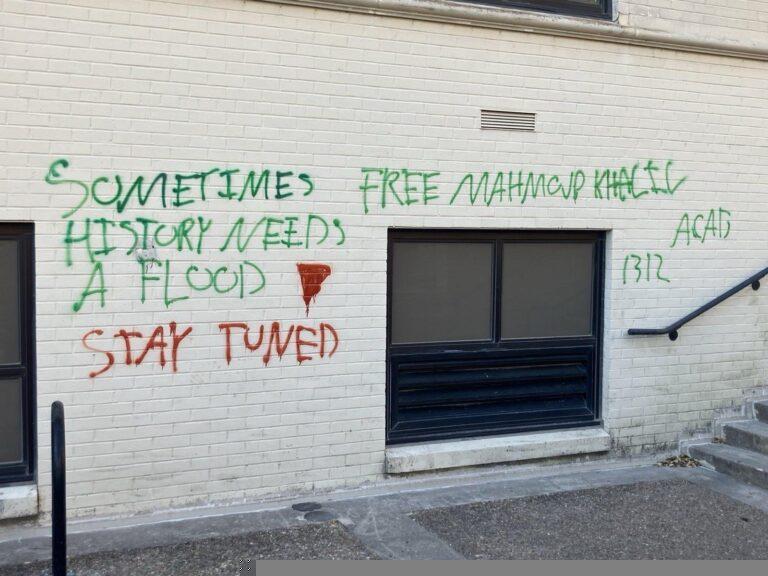
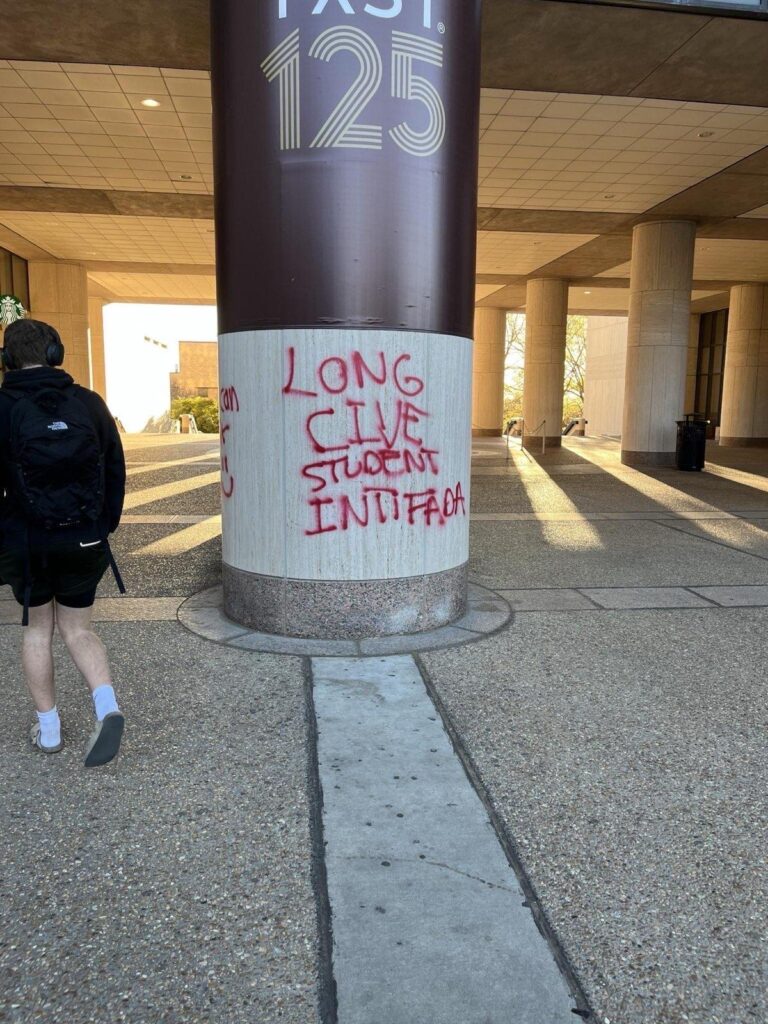
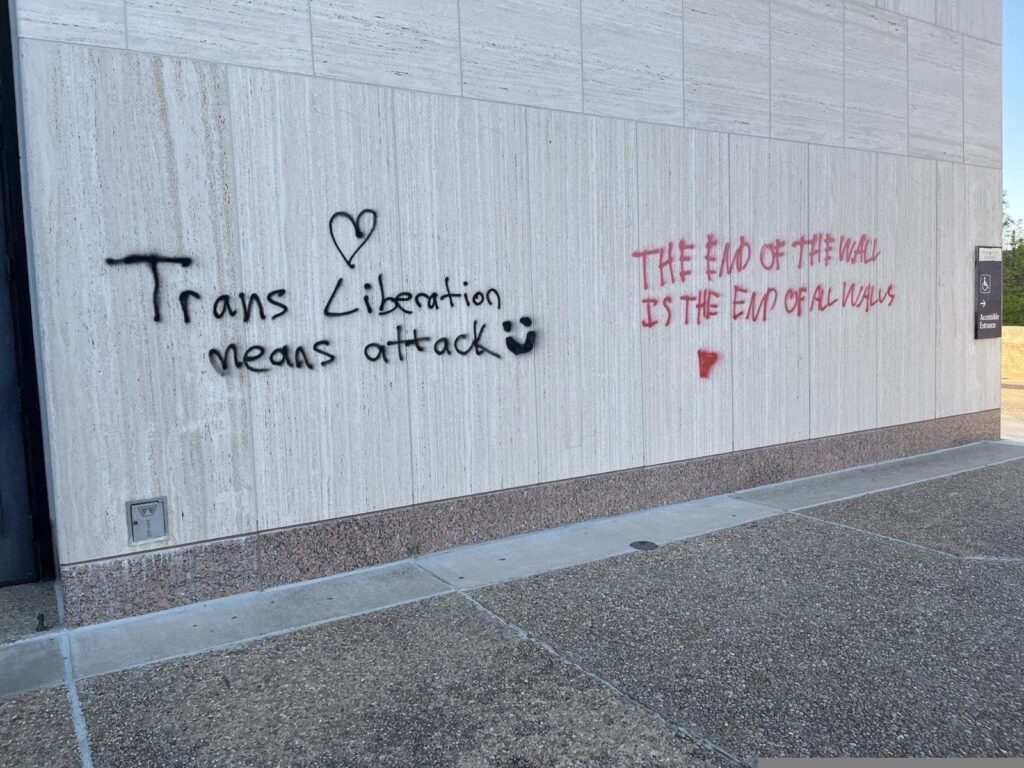
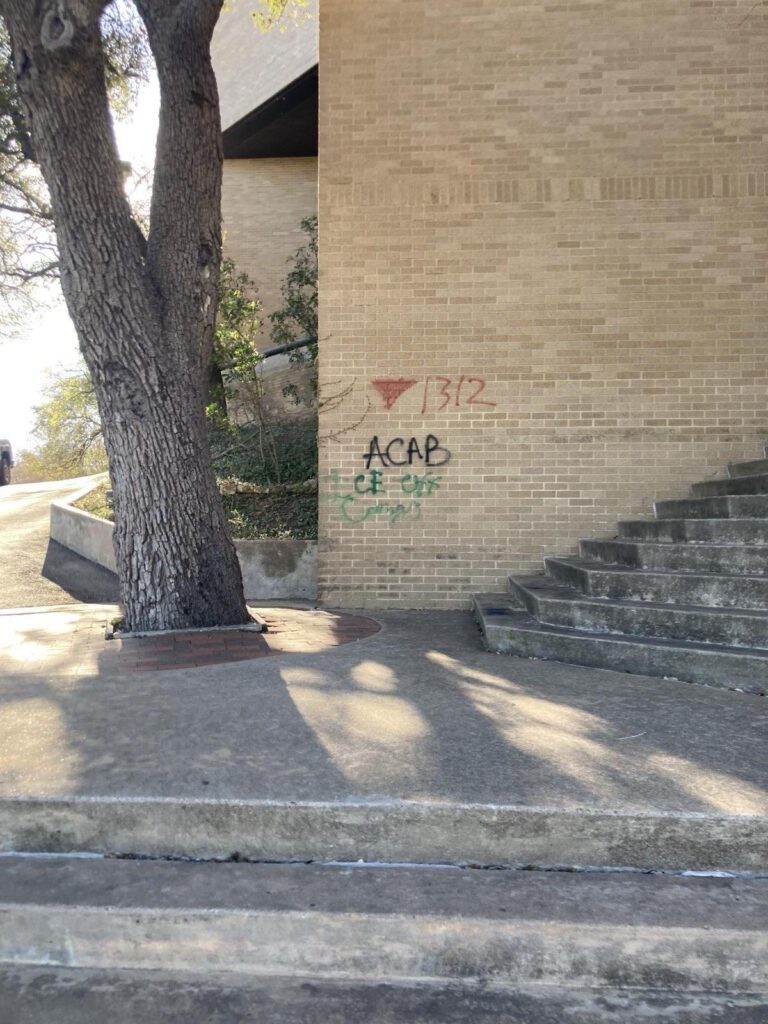
We typically prefer that actions speak for themselves, but perhaps a few words are due. In the face of renewed genocide and mass deportations, all that is left is what must be done. Taking up the task of disruption, sabotage, and attack is not something we do lightly. The people of Gaza have repeatedly called for mass student escalation. We’ve witnessed targeted deportations of politicized students, workers, and teachers with legal status; a wave of student protests repressed and occupations torn down, and paltry concessions rescinded by university admin.

We ask: what did a protest of over 500 students last spring at the Stallions accomplish? We stood and chanted as fellow students at UT were teargassed. Last week, the Party for Socialism and Liberation hosted a small protest of barely a few dozen. Then everyone went home. Held on the square, this event made front cover of the University Star alongside an opinion piece by the Star’s editorial board advocating “proper avenues” of “political expression.” They even dared to invoke the expelled San Marcos 10 in an effort to downplay a little graffiti. Why? The university can better control every aspect of the narrative if we allow them to dictate proper political expression.

Our detractors have labeled us vandals, criminals, outside agitators, domestic terrorists, radicals/extremists. Though these titles are certainly an honor, we remain your humble neighbors, colleagues, & classmates. Living in the heart of US imperialism necessitates actions that disrupt business as usual. We do not fear political repression, but instead a return to normalcy.

Some students have bemoaned the defacing of their “beautiful” campus. Fuck you lol. This university is complicit in funding Israeli genocide and actively collaborating with ICE against the will of its student population. It was already an extension of an active warzone; our political act simply reminded people of that. It is students who make this campus beautiful, because it is our campus.

Others pointed out the inconvenienced sanitation workers forced to take such art down. For the first time, students recognized the existence and working conditions of underpaid, primarily immigrant workers who lack union representation on this campus. But rather than lay those concerns at the feet of a, frankly overpaid, administration whose campus is expanding unsustainably, these students prefer to weaponize said workers against a political movement. How often has the student body taken it upon themselves to guarantee the survival of these workers or their families?

UPD has claimed all its efforts are being concentrated on unveiling us while sexual harassment, assault, hazing, and homophobic and racist violence are still mainstays at this University. Perhaps it would be best if they concentrated on those, if they weren’t so often guilty of excesses of violence themselves.

Another point of interest was the overwhelming discussions held in the wake of our graffiti. Through Reddit, Instagram, and classrooms debates were held, photographs taken, interviews conducted, and statements released. The University Star would have you believe otherwise, that “many students have already ceased conversations surrounding it.” A boldface lie in an attempt to downplay an event the paper references in 3 different articles this week.

Our beloved University President, Kelly Damphouse, even took to the battlements of his own Instagram post responding to the flurry of negative comments he received from Texas State students, and liking messages such as “we stand with you Kelly.” Seems his public outreach coordinator needs to run some trainings with him, feeling the need to respond to each and every negative comment with hundreds of likes.

Funny thing that few people recall about Kelly: his doctorate is in counter-terrorism, counter-intelligence, and studying resistance movements. What that means, dear reader, is that the president of our university has a degree in stifling unrest. His position befits the degree as he has spoken wearily of anti-war student activists of the 60’s and compared them to today’s protests around Palestine. A fed for a president who needs to lay off the ‘gram lest he make a fool of himself. We are happy to report that the vast majority of student body responses on social media that we witnessed were positive 🙂

Finally, we come to the particular questions and answered that spurred this communique. Why did we do it? Should you do it? How? Was it easy?

We did it because it was a step, a small one, towards escalation. Graffiti carries a certain transgressive and sensationalist appeal that gets people talking. However, this was by no means a performative action designed only to create commotion. IT is part of a sustained national attempt to attack institutions responsible and hold them accountable. In the spirit of the Merrimack 4, we think it important to bring the war home. As parades, marches, protests, and community events have their place in revolutionary change, so too does direct action, disruption, and clandestine activity.

With minimal planning, some spray paint, and committed friends we reveal ways to strike back. It was easy. “stay tuned” and “you can do it too” were not just slogans but calls to action. Be bold. Be creative. Have fun, because it is fun to revolt. It’s the University’s responsibility to divest from genocide and keep ICE out. We can bleed their pockets. Material damages is money they cannot spend elsewhere. We take risks because we can, and once you realize it’s possible so can you.

Source: Austin Autonomedia